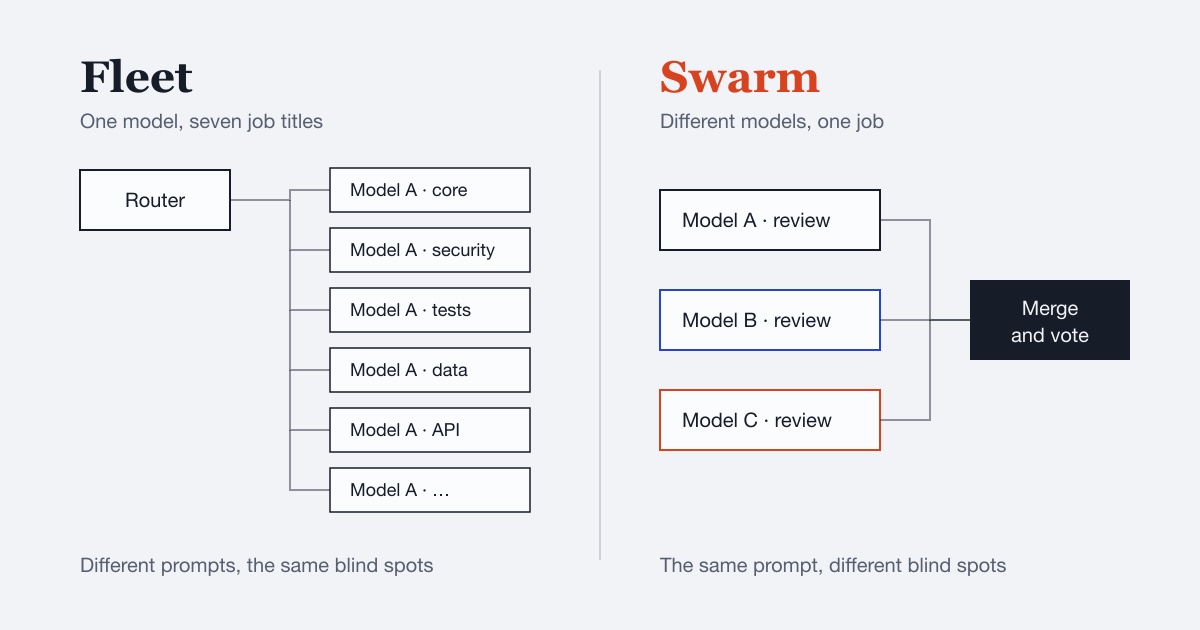
For code review agents, a swarm beats a fleet. A fleet is one model split into specialists: a security reviewer, a tests reviewer, an API reviewer, each with its own prompt. A swarm is several different models all given the same job on the same diff. We built the fleet first, wrote guides on this site recommending it, and ran it in production for three months. Then we measured both on the same pull requests and deleted the fleet.
This is an opinion piece with our own numbers in it. We build Mergestorm, so read it as a field report from one team, not a neutral survey.
The two shapes
Fleet. A router reads the diff and hires specialists by topic. Ours had a generalist we called Core and seven lanes: security, performance, architecture, tests, data, API and frontend. Every lane ran on the same model. What made a lane a “security reviewer” was a paragraph of role text.
Swarm. No roles. Two or three different models each review the whole diff independently, in parallel, with the same instructions. A merge step joins duplicate findings. With three models you can also vote: post only what at least two of them reported.
Why the fleet looked right
It is how people organise. A human security engineer finds things a generalist misses, so an agent told to be a security engineer should too. The design also produces a satisfying picture: one router, eight boxes, arrows. We drew that picture in our orchestration guide.
The flaw is in the analogy. A human specialist knows different things from the generalist. A role prompt does not give a model new knowledge. It is the same model, with the same training and the same gaps, looking at the same diff with a narrower brief.
What we measured
We keep an offline bench of 50 real pull requests with an answer key of 173 known bugs, and score reviewers by how many of those bugs their comments match. In November 2026 we ran the comparison we should have run in August.
| Added to one generalist review | Extra known bugs found |
|---|---|
| The topic specialists (same model, role prompts) | 5–11 |
| One more generalist review by a different model | 20–28 |
We report ranges because results on a bench this size move between runs. One extra reviewer on a different model found roughly two to five times as many additional bugs as the whole specialist roster.
A second number explained why. On five of our own production pull requests we checked each specialist finding against that specialist’s own topic. About 45% did not. The lanes kept converging on the same thing: the biggest bug in the pull request, reported by the security lane, the tests lane and the architecture lane in slightly different words. The role text was a suggestion. The model went where it would have gone anyway.
A specialist prompt changes what a model is asked. It does not change what the model can see.
Why a second model helps more
Two reviews only add up when their misses are different. Seven lanes on one model share one set of blind spots, so their misses are strongly correlated: what Core cannot see, the security lane mostly cannot see either. Models from different labs are trained on different data with different methods. They fail in different places. That difference is the whole value, and a prompt cannot buy it.
It is the same reason a second human reviewer is worth more than the first reviewer rereading the diff with a checklist. The checklist helps a little. The second pair of eyes helps more.
What a swarm makes possible: a vote
Independent reviewers give you something a fleet cannot: agreement as a signal. If three models read the same code separately and two of them flag the same line, that finding is more likely to be real than one flagged by a single model. So with three models you can post only what at least two agree on, and trade some true findings for less noise.
A fleet has no equivalent. Its lanes are assigned different topics on purpose, so when two of them agree it is an accident of overlap, and when they disagree it means nothing.
What we changed
On 21 November 2026 we removed the router and the seven topic lanes from Vortex, Mergestorm’s reviewer, and replaced them with one setting:
| Swarm mode | Who reviews the first push | What is posted | Credits |
|---|---|---|---|
| Off (default) | One model | Every finding | 1 |
| Normal | Two different models | Every finding, duplicates merged | 2 |
| Max | Three different models | Only findings at least two models agree on | 3 |
The details that matter in practice:
- Every model reviews the same plan of the diff, in parallel. No model sees another’s findings.
- In normal mode the merge step may join two findings but never drops one.
- In max mode, agreement means the merge step joined the finding across models, or another model reported the same file within five lines. A note that needs a human decision is never voted out.
- If a model does not finish in time, the review goes on without it, the summary says how many models reviewed, and its credit is not charged.
- Swarm runs on the first review of a pull request. Later pushes get one model, whose job is to check what was open.
From the CLI it is mg review --swarm max. How this fits
into a review loop is in
How to structure an AI PR review loop.
Where this argument stops
An opinion is only useful with its limits attached.
- It is one bench. Fifty pull requests, our answer key, our prompts. Two runs of the same configuration differ by a few points, which is why the table shows ranges. Your codebase may behave differently.
- A swarm costs more. Two models cost twice one model. We are claiming that a second model is a better use of the second credit than a specialist is. We are not claiming every pull request needs a second credit. A typo fix does not.
- A better single reviewer can beat a swarm. A prompt change to our single reviewer raised its catch count by nearly as much as a second model did, though it also posted more comments that matched nothing. Tune the one reviewer first. It is cheaper.
- The vote is conservative. A real bug that only one model sees is dropped in max mode. That is the trade. If you would rather read every finding, use two models and no vote.
When a specialist still earns its place
We kept two. Neither is a topic lane.
Governance does not review the diff. From the third follow-up round it reads the history of the pull request and answers one question: is this converging, or should someone stop and rethink it? Seam checks the joins between the layers of a stacked pull request, which no single-layer review looks at.
That gives a rule we now use for any proposed agent:
A specialist is worth hiring when it gets a different input or answers a different question. A different job title is not enough.
A security agent that reads the output of a static analyser, or the dependency advisories for the lockfile, passes that test. A “security agent” that reads the same diff with a sterner prompt does not.
Test it on your own pull requests
You do not need our bench. You need about twenty merged pull requests where you know what went wrong afterwards: a follow-up fix, a revert, an incident.
- Write down the known bugs for each pull request. That is your answer key.
- Run one reviewer on each pull request as it was when first opened. Count the known bugs it caught and the comments nobody would act on.
- Add specialists on the same model. Count again.
- Remove the specialists and add a second reviewer on a different model. Count again.
- Run each configuration twice. If two identical runs differ by more than the gap between configurations, you have not learned anything yet. Add pull requests.
For what to track once a reviewer is running on live pull requests, see AI code review metrics: a 30-day scorecard.
The short version
- Same model, different prompts: mostly the same findings, at several times the cost.
- Different models, same prompt: different findings, and agreement you can use as a filter.
- Keep a specialist only when it sees something the generalist cannot.
- Measure on pull requests with known bugs before you believe any of this, including us.