AI PR code review (the same thing people search as AI PR review) is automated code review that runs on pull requests: it reads the diff, leaves comments where humans would, and—when the tool is built for it—suggests or pushes fixes. The point is not to fire your reviewers. It is to stop every PR from waiting on a cold first pass.
“AI PRs” gets used two ways: pull requests reviewed by AI, and pull requests written by coding agents. This guide is about the first. The second needs it more, because an agent can open pull requests faster than anyone can read them.
PR code review, with a bot in the loop
Classic pull request review is a human reading a diff, asking for changes, and approving when the change is safe enough to merge. That still matters. What breaks at scale is latency: reviewers are busy, stacks pile up, and “LGTM” becomes a rubber stamp because nobody had time for a real pass.
AI PR review inserts a consistent first (and sometimes second) pass on every pull request. Good systems:
- Comment inline on the lines that matter
- Stay quiet when the change is fine
- Escalate when the diff is large, risky, or crosses many files
- Optionally ship a patch instead of only a complaint
Automatic on the PR — not “ask your agent”
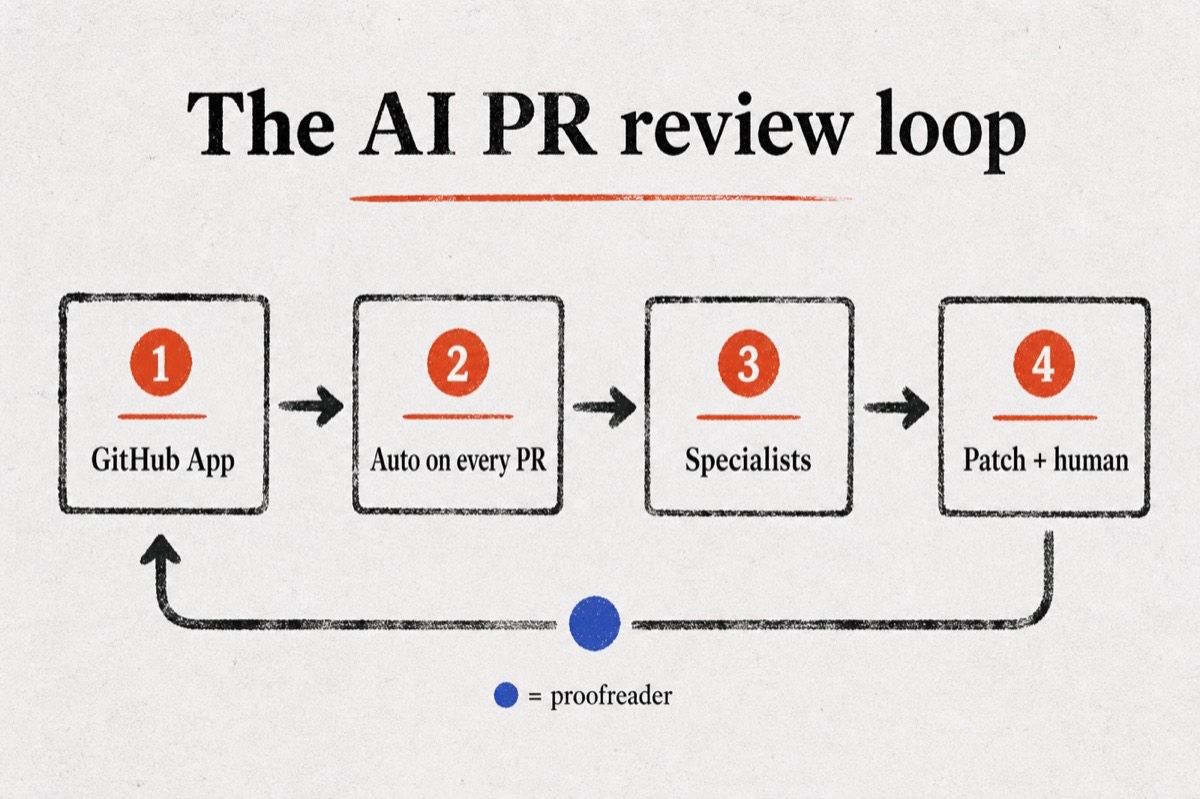
The usual install is a GitHub App (or the GitLab / Bitbucket equivalent) on the repo. When a pull request opens or a new commit lands, the reviewer runs by itself. Nobody pastes a diff into chat. That is the point of AI PR review: it is a hook on the pull request, the same way CI is a hook on the push.
That is different from asking Cursor, Claude, or Copilot in the editor to “review this.” An IDE agent is useful, and it is still optional. It does not run on the PR your teammate opened at 6pm unless someone remembers to invoke it. AI PR review is the automatic pass — CodeRabbit, Cursor’s Bugbot, Mergestorm’s Vortex, and others in this category all start from that GitHub App shape.
What it is good at
- Coverage. Every PR gets eyes—even the “tiny” ones that usually skip review.
- Speed. Feedback in minutes, not tomorrow’s standup.
- Nitpick load. Naming, obvious bugs, missing tests, unsafe defaults—cleared before a senior opens the tab.
- Risky diffs. Auth, migrations, concurrency, and wide refactors benefit from a deeper automated pass before merge.
What it should not pretend to be
AI review is not a substitute for product judgment, architecture ownership, or knowing your customers. It will miss context you have never written down. It can be confidently wrong. Treat it like a sharp junior: useful on every PR, never the only approver on something that can take production down.
The popular tools — honest map
Several products do the automatic GitHub App job. We build Mergestorm, so we are not neutral; the others are real and widely used:
- CodeRabbit — line comments and summaries on the PR; many teams’ first “bot reviewer.”
- Cursor Bugbot — Cursor’s PR-time reviewer (again: on the pull request, not only in the editor).
- Vortex (Mergestorm) — inline comments, with a fleet of specialists rather than one generalist blob.
Pick on install friction, comment quality, and whether the product can close the loop (next section) — not on a leaderboard we did not run.
Close the loop with a patch agent
A comment that says “this can be null” still leaves a human to write the fix. Some stacks add a patch agent: when the change is mechanical, it pushes a commit to the branch so you review the patch, not the essay. On Mergestorm that job is Cyclone. Vortex finds; Cyclone applies. Humans still own merge.
Without a patch path, AI PR review is a very fast sticky-note machine. Useful. Incomplete if the same nits come back every sprint.
Review loops: not every agent on every push
“Run the whole fleet on every synchronize” gets expensive and noisy. A loop decides which agents fire when:
- On open (initial review). Assemble coverage — Core plus specialists that match the diff (security, tests, API, frontend, …). Lanes fan out in parallel so you are not waiting in a queue.
- On later pushes (follow-up). Re-hire sticky — only specialists that already found something, so they can verify the fix. Lanes that came back clean retire.
- On PR state / round. Some auditors are round-gated (for example a trajectory / governance pass after several heads) instead of pinned forever. They ask a different question: is this PR still the original ask?
That is how Vortex is built: findings and published rounds drive the next hire, not a random extra specialist every push. For the longer playbook see how to structure an AI PR review loop.
Three jobs on a modern review stack
On Mergestorm those jobs map to agents (not plan names). How they hand work to each other is covered in code review agent orchestration:
- Vortex — inline comments on the pull request
- Cyclone — patches pushed back to the branch
- Tempest — deeper review when the diff is risky
Maelstrom is a plan name, not an agent. You pick intensity with the agents; you pick billing with the plan.
How teams usually adopt it
- Install on the repo and require a bot pass before human review.
- Tune noise: fewer low-value nits, more signal on correctness and safety.
- Keep humans for design, product fit, and merge ownership.
- Use stacked PRs so review stays small — watch the Mergestorm CLI walkthrough if you want the terminal workflow.
A short definition you can steal
AI PR code review = automated, diff-aware review that runs on every pull request so humans review decisions, not first-pass chores.
If you want a hands-on checklist for what to still verify yourself, see Pull request review checklist (2026). For what a good reviewer should actually flag on a normal diff, see what AI code review should flag on a pull request. For how to hire one agent vs a fleet without paying on every push, see AI PR review loops.